Endocrine Disruptors: Hidden Chemicals in Your Bathroom Cabinet
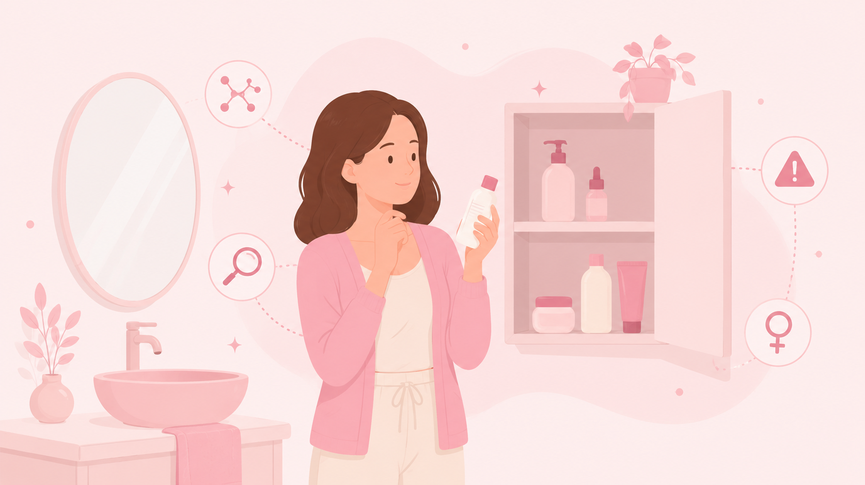
The average bathroom cabinet contains dozens of chemicals known as endocrine disruptors, which interfere with hormone production. Endocrine disrupting chemicals (EDCs) have been shown to impact fertility, hormonal health, and long-term wellness.
These chemicals are absorbed through intimate contact with our bodies, making their way into your bloodstream and causing issues over time.
What Are Phthalates and Parabens?
Parabens refer to a group of compounds derived from benzoic acid, which are widely used as preservatives in pharmaceutical and cosmetic products and in the food industry. Introduced in the 1950s to raise quality control and safety in mass produced items, parabens block mold and bacterial growth and extend product shelf life.
The most common parabens you’ll spot on ingredient lists are methylparaben, butylparaben, ethylparaben, and propylparaben. Endocrine disruptors in skincare are ubiquitous – these chemicals are lurking in everything from lotions and cleansers to the plastic packaging on bottles.
Phthalates are various salts or esters of phthalic acid used as “plasticizers” to give products durability and a uniform texture, like helping hairspray to hold or keeping lotion buttery. This group of chemicals can be found in everything from plastic wrappers and vinyl curtains to scented candles and deodorant.
How They Mimic Estrogen
Estrogen is a hormone produced by your body that is involved in a range of metabolic and endocrine functions, including menstruation, fertility, and bone density. Natural estrogen functions as a “key” that fits into receptor “locks,” triggering specific bodily processes. Because parabens and certain phthalates are structurally similar to natural estrogen, they can bind to the same cellular estrogen receptors and mimic the effects, such as cell division and growth.
Though they don’t fit perfectly, parabens and phthalates can still force the lock open enough to displace your body’s natural estrogen, tipping your body’s delicate hormonal balance. Artificially elevated estrogen levels can cause all kinds of problems, like hot flashes, infertility, and even an increased risk of cancer.
Researchers have been examining the adverse effects of parabens and phthalates for the last 20 years, and while there have been studies linking these chemicals to increased risk of certain conditions like breast cancer, the FDA and CDC have not issued any decisive warnings.
The EU has taken a stronger stance, severely restricting their use and banning several parabens and phthalates across food-contact materials, cosmetics, and toys.
Endocrine Disruptors In Period Products Are Especially Dangerous
Chemicals can leech into our skin through intimate contact, and there are few things more intimate than period products. Though endocrine disruptors can be found in most modern household products, studies show that phthalate concentrations are significantly higher in period products like sanitary pads and tampons than commercial plastic wrappers.
Moreover, we absorb more chemicals through period products than handling plastic wrappers. Vaginal and vulvar tissue is much more vascular and permeable than the skin on your hands or face, and chemicals are absorbed directly without undergoing first-pass metabolism, leading to higher uterine concentration.
Since period products are in direct contact with genitalia for extended amounts of time, more endocrine disruptors can be absorbed into the reproductive system. Over time, EDCs can accumulate in your body and significantly disrupt hormonal function.
Intimage Hygiene Swaps To Reduce Chemicals
From menarche until menopause, the average woman will use around 11,000 menstrual products over 1800 days of total menstruation; that’s five years of potential chemical exposure. Fortunately, you can reduce your exposure by swapping certain period products that have been shown to contain high levels of EDCs for safer alternatives.
Swap Tampons for Menstrual Cups
Standard tampons you buy at the grocery store or pharmacy are made of a blend of rayon and cotton. Studies show that most tampons contain trace metals (such as arsenic and lead) and plastic additives; even 100% “organic cotton” tampons have some plastic additives on the outside to hold their shape. Moreover, if you’re not bleeding very much, pulling a dry tampon out can leave synthetic micro-fibers behind in the vaginal canal.
Swapping tampons for menstrual cups made of 100% medical-grade silicone or rubber significantly reduces the amount of EDCs absorbed through intimate contact. Top-tier menstrual cups are made with 100% medical-grade silicone that creates a completely inert material barrier with zero plastic particle shedding, meaning it doesn’t break down or leave synthetic fibers behind to be absorbed into your body.
Not only are menstrual cups better for your health, they’re also better for the environment (and your wallet). A high-quality menstrual cup can last 5–10 years, compared to the hundreds of tampons you’d have to go through in the same time frame.
Swap Sanitary Pads and Panty Liners for Period Panties
Among disposable period products, panty liners contain the highest concentration of phthalates like DEHP. While most period panties contain some synthetic materials to form a leakproof barrier, the amount of sheddable microplastics is significantly less than sanitary pads or liners.
Look for labels that offer a cotton leakproof lining made without PFAS and brands that focus on materials with a natural enzyme process and transparently test for toxins.
Conclusion
We live in a world of chemicals – EDCs are in food wrappers, shower curtains, hand lotions, and laundry detergents. Tampons and panty liners in particular can transmit a significant amount of EDCs due to the prolonged and intimate nature of their use.
But while handling EDCs is an unavoidable part of modern life, you can reduce the amount of EDCs absorbed by your body through swapping out disposable period products for ones with less plastic particle shedding.

Clara Wang is a freelance writer based in Nashville, TN but often found abroad. She mostly muses about the three best things in life: Food, sex, and music. Her work has been featured in publications such as Eater Austin, Eater Nashville, Giddy, Buzzfeed, Refinery29, the Austin Chronicle, the Austin American Statesman, and the Daily Dot.